
The 5-Step Framework Behind High-Performing B2B Channel Loyalty Programs
Most channel incentive programs are built backwards.

Companies pick a rewards catalog, set a budget, blast an announcement to partners, and wait for results. When engagement flatlines six months in, they tweak the prizes and try again. The cycle repeats.
The problem isn't the rewards. It's that reward selection happens before anyone has defined what the program is supposed to accomplish. High-performing companies treat channel loyalty as a business strategy. They build programs that align partner behavior with measurable outcomes — and they see it in the numbers: stronger engagement, higher revenue, and profitability up to 23% higher than programs that go unmanaged after launch.
After 50 years helping B2B organizations design and run channel incentive programs, we've distilled what they do differently into five steps. The sequence matters as much as the steps.
TLDR
Most channel loyalty programs fail because they're built backwards — copy-pasted structure, no defined success metrics, and rewards that don't match how partners actually make decisions. This post breaks down a five-step framework for building programs that work: define what winning looks like, segment partners, design mechanics that drive behavior, activate participation, and measure what matters. Read it if your program has engagement on paper but not in practice.
Ready to build yours? Download the B2B Channel Loyalty Blueprint →

Step 1: Define What Success Looks Like Before You Design Anything
The most common channel program mistake is skipping straight to incentive design. Before any rewards, tiers, or platforms are chosen, you need to know what you're trying to accomplish and how you'll measure it.
That means selecting three to five KPIs tied directly to business priorities: sales lift, market penetration, product adoption, partner retention, or some combination. Then setting quarterly and annual targets for each one.
When KPIs are defined upfront, every subsequent program decision — who to target, what to reward, how to communicate — has a clear filter. Without them, you optimize for activity, not outcomes.
The full KPI framework, including how to document scope, eligibility, and budget in a one-page stakeholder brief, is in the B2B Channel Loyalty Program Blueprint. Download the complete blueprint →
Step 2: Stop Treating All Partners the Same

Not every partner creates value in the same way. A national distributor has different motivations than a regional contractor. A dealer focused on advocacy behaves differently than one chasing sales volume. A single program designed for all of them ends up mediocre for everyone.
Effective segmentation looks at partner type, size and scale, product line focus, behavioral patterns like training completion or advocacy, and growth potential. The goal isn't complexity — it's relevance. Behavior-based segments let you reward what actually matters for each audience without overspending on incentives that don't move the needle.
43% of customers have chosen one manufacturer or wholesaler over another because of a loyalty program. Relevance is a competitive differentiator.
The numbers back this up.
One loyalty program for a distributor client was reaching just 25% of eligible contractors. A full redesign — clear eligibility, universal rules, contractor-specific rewards — turned that around. Registered contractors hit 26% above goal and overall sales climbed 23%. Designing specifically for the audience you need to reach is what produces those numbers.
Step 3: Build Mechanics That Are Simple Enough to Actually Work
Complex programs don't earn more engagement. They earn less.
The most impactful channel programs combine three structural elements:
- Tiers that feel attainable, like Bronze, Silver, and Gold with clear progression paths
- Points tied to the specific behaviors that drive business results
- Gamification elements like leaderboards, progress bars, and themed sprints that create short-term urgency without losing sight of long-term goals
Tiered structures work because they give every partner something to work toward — not just top performers.
50% of mid-tier customers earning points. 27% of top-tier customers earning travel. A 23% increase over a $180 million sales projection. That result came from building distinct reward structures for each tier, not forcing every partner into the same program designed for top performers.
Simple rules build trust and speed adoption. Over-engineered programs create friction and give partners a reason to disengage. When the mechanics are clear, participation feels within reach.
Step 4: Activate Participation Through Reward Choice and Consistent Communication
A well-designed program stalls when partners don't encounter it in their day-to-day. Activation is about visibility — keeping the program present, reinforcing progress, and giving partners regular reasons to re-engage.
Two levers matter most.
Reward choice. A single reward type alienates segments. A strong rewards strategy balances everyday options like merchandise and eGift cards with aspirational experiences like travel and events, so the program connects with what partners actually want. Choice increases perceived value even when total reward cost stays controlled.
Communication cadence. The most effective programs run on a planned cadence: a teaser before launch, a formal launch, monthly statements with point balances and redemption options, and ongoing sprint promotions to sustain engagement. Supplier spotlights, success stories, and rotating homepage content keep the program present between major touchpoints.
Our full communications cadence is outlined in the B2B Channel Loyalty Program Blueprint. Download now →
Your communication cadence isn't a nice-to-have — it's what determines whether partners actually redeem.
Over 95% of issued rewards redeemed — across several thousand customers in the US and Canada. That number came from a deliberate multi-channel communications strategy, not from the reward catalog.
Step 5: Measure, Optimize, and Don't Stop

Programs that get managed grow. Programs that don't, fade.
Step 5 is where most organizations underinvest — and where the biggest performance gaps appear.
Ongoing visibility into participation rates, redemption behavior, click-through rates, and sales lift lets you retire what isn't working and double down on what is. It also keeps leadership engaged and budgets defended. Assign KPI owners, share a simple dashboard monthly, collect qualitative feedback from participants, and treat optimization as a recurring discipline — not a one-time post-launch review.
The Framework in Practice
These five steps — objectives, segmentation, mechanics, activation, and measurement — work as a system. Skipping any one weakens the others. Applied together, they turn a channel program from a cost center into a growth engine.
Research from the Channel Marketing Group found that 51% of contractors belong to at least one manufacturer, distributor, or retailer loyalty program — and 48% say those programs directly increased their patronage. The opportunity is there. Whether your program is designed to capture it is the question worth answering.
The full blueprint goes deeper on each step, including design directives, structural advantages, critical checks, and the KPI scorecard framework. Download the Complete B2B Channel Loyalty Blueprint →
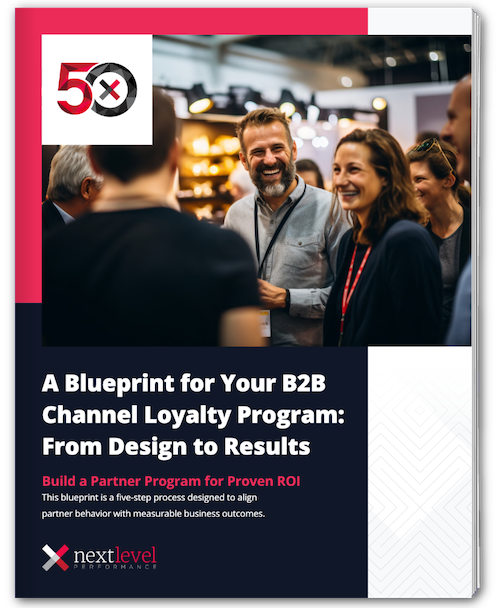
💡 Ready to discover how an incentives program can transform your channel strategy?
Download our full guide below and connect with our Sales Incentives and Customer Loyalty team.
Estimated reading time: 8 minutes
Frequently Asked Questions
About B2B Channel Loyalty Programs
Rebates are transactional — a partner hits a volume threshold and gets money back. A channel loyalty program is broader and more behavioral. It rewards a wider range of actions (training, product mix, co-marketing participation) and typically builds ongoing engagement rather than one-time payouts. Many programs use rebates as one component within a larger loyalty structure, but they're not interchangeable terms.
Start with your business objectives and work backward. If your priority is moving a specific product line, reward sell-through of that product. If you're trying to increase partner expertise, reward training completions. The mistake most programs make is rewarding everything equally — which dilutes the impact and makes it harder for partners to know what to focus on. A well-designed program typically rewards two to four core behaviors tied directly to measurable outcomes.
Non-cash rewards consistently outperform cash in channel programs — not because cash isn't valued, but because merchandise, experiences, and travel create a stronger emotional connection and are more memorable. That said, the best reward mix depends on your partner profile. A program serving independent dealers has different motivators than one serving large regional distributors. Understanding your partners before you build the reward structure is one of the most important steps you can take.
A platform isn't just helpful — it's what makes a channel loyalty program scalable and sustainable. Without one, you're managing communications, tracking performance, and fulfilling rewards manually, which breaks down quickly when you're working with a large, dispersed partner network. The right platform becomes a central hub where distributors can log in, see where they stand, track their progress toward rewards, and stay connected to your brand year-round. That visibility and accessibility is often what separates a program partners actively engage with from one they forget about.
Consistent, targeted communication is the biggest lever. Partners who know where they stand relative to their goals stay more engaged than those who only hear from you at launch and at payout. A good platform makes this manageable at scale — automated milestone notifications, progress updates, and personalized messaging mean your partners feel seen even when your network spans hundreds of locations. Beyond communication, tiered structures that give partners at different performance levels something to work toward help sustain momentum from Q1 through Q4.
Sources:
Incentive Research Foundation: Top 10 Things Top Companies Do Differently
Incentive Research Foundation: Incentives, Motivation, and Workplace Performance
2025 Channel Marketing Research
Harvard Business Review: The Value of Keeping the Right Customers
Gallup: Workplace Performance and Engagement Research



Let’s Talk
Ready to take the next step?
Contact us today to connect with one of our experts.